

Introduction
To face today’s climate challenges, organizations and companies need to assess their carbon footprint. This carbon footprint encompasses several scopes and categories. Scope 1 is one of the central elements of this carbon footprint and its proper understanding allows organizations to effectively reduce their GHG emissions. In this article, discover the different categories of Scope 1 and their challenges for companies.
What is scope 1?
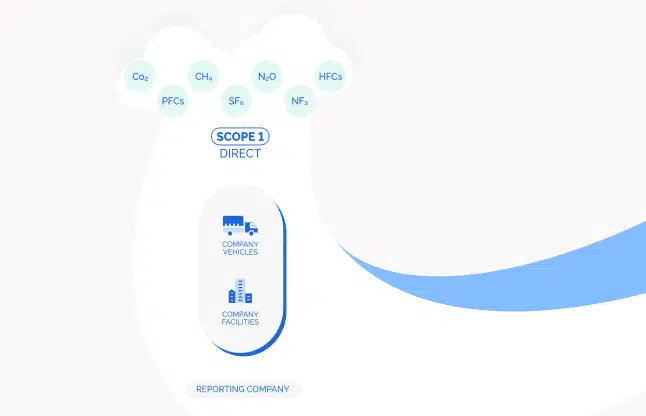
Scope 1 is one of the key perimeters of the carbon footprint. this scope refers to the direct greenhouse gas emissions generated by the activities of a company or organization. These emissions come from sources controlled or owned by the organization.
Unlike scope 2 and 3, which concern indirect emissions, scope 1 focuses exclusively on what the company emits directly, such as:
- Fuel combustion: This refers to the fuels consumed in the company’s facilities, but also to the vehicles it owns or controls.
- Process emissions: Which include emissions directly from production processes, such as chemical reactions in the manufacture of products.
- Fugitive emissions: These include leaks of greenhouse gasses, such as freon from air conditioning systems or methane losses during the distribution of natural gas.
What are the different categories of scope 1?
Scope 1 is broken down into various categories, each representing a specific type of direct greenhouse gas (GHG) emissions.
Stationary emissions
Stationary emissions arise from the combustion of fuels in organizations’ stationary facilities, such as boilers, furnaces, or generators. For example, a factory that uses a furnace to process raw materials or a company that heats its premises in winter generates stationary emissions. the amount of gas emitted depends on the type of fuel used and the efficiency of the equipment.
Mobile emissions
Mobile emissions arise from the combustion of fuels in vehicles or mobile equipment owned or controlled by the company. This includes company cars, trucks, company planes, boats, and even some types of heavy machinery used on construction sites. every trip, and every liter of fuel consumed contributes to these emissions.
Industrial processes
In addition to combustion, some industrial activities directly emit greenhouse gasses, due to chemical or physical reactions. for example, cement production releases carbon dioxide when limestone is heated. These emissions are not directly related to the energy but to the process itself.
Fugitive emissions
Scope 1 also takes fugitive emissions into account. This refers to emissions that escape during the production processes or use of certain equipment. They are not intentionally released examples include refrigerant gas leaks from air conditioning or natural gas systems in pipeline infrastructure. Even though they may seem minor, these emissions can have a significant impact on the environment, as some gasses have a high global warming potential.
Other specific categories
Some industries may have emissions sources specific to their field, such as emissions from solvent use agriculture, for example, generates emissions related to the enteric fermentation of ruminants or animal waste management while some organizations resort to the use of biomass fuels, such as wood. The combustion of biomass generates emissions that should be taken into account in the calculation of scope 1. It is crucial to correctly identify and categorize these emissions for an accurate carbon footprint assessment.
Identifying the different scope 1 categories is essential for reducing carbon emissions
Scope 1: the challenges of the different categories
Accurately classifying scope 1 emissions is more than just an administrative formality. Indeed, this categorization has many issues:
- Optimization of reduction strategies: Accurate categorization of scope 1 allows companies to effectively target areas where emission reductions can be maximized. This avoids unnecessary investment in areas that have less impact.
- Credibility and trust: Stakeholders, whether investors, customers, or employees, are increasingly attentive to the environmental performance of companies. Accurate categorization enhances an organization’s credibility and transparency.
- Regulatory compliance: With the emergence of stricter emissions reporting regulations, miscategorization can lead to sanctions, penalties, and even litigation.
Accurately classifying scope 1 emissions is more than just an administrative formality. Indeed, this categorization has many issues:
- Under- or over-reporting emissions: A misidentified category can mean that some emissions are counted twice, while others are omitted. This gives a distorted picture of the true carbon footprint.
- Wrong strategic direction: Based on flawed data, a company may allocate resources to emissions reduction initiatives that do not have the expected impact, neglecting the real problem areas.
- Reputational risk: In an era where environmental responsibility is under scrutiny, a company that publishes an incorrect carbon footprint, even unintentionally, can suffer repercussions in terms of image and trust.
Accurate categorization not only ensures the accuracy of carbon footprint data but also plays a key role in determining a company’s strategy and stakeholder positioning
Thus, it is advisable to surround yourself with experts or to use carbon footprint software such as the carbon footprint calculation software d-carbonize, in order to carry out a correct and accurate assessment of scope 1 emissions serving as a basis for informed decision-making.