
B Corp certification : issues, certification, acquisition process, and support
Challenges
In a climate marked by stricter ESG requirements and growing pressure from customers, investors, and stakeholders, companies are being urged to demonstrate their commitment to sustainability in concrete terms. B Corp® certification has established itself as one of the most rigorous and widely recognized standards in the world, enabling companies to both build a robust CSR framework and provide credible, independent proof of their efforts.
What is B Corp® certification?
B Corp® certification is awarded by B Lab. It is open to for-profit companies of all sizes, in all sectors, and with any legal structure, and evaluates the company as a whole, not a specific product or service.
Unlike a product certification, B Corp® certification attests that the company integrates social, environmental, and governance objectives into the core of its business model. To date, approximately 9,000 companies worldwide are B Corp® certified, spanning more than 90 countries and 160 industries.
Note: Although the assessment questionnaire is available for free, certification requires a fee. The cost varies depending on the company’s revenue and size.
How does the assessment work?
The B Impact Assessment (BIA)
The assessment is based on the B Impact Assessment (BIA), a structured questionnaire consisting of approximately 200 questions, which measures the company’s performance across five key areas: governance, employees, customers, communities, and the environment.
A minimum score of 80 out of 200 is required to submit an application. For reference, the median score of certified companies is around 96 points.
Prerequisites
Before beginning the BIA, the company must meet several basic requirements: be legally incorporated, have been in operation for at least 12 months, comply with applicable laws, and adopt stakeholder-oriented governance. It must also establish its risk profile using B Lab’s analysis tool, which determines the additional requirements that will apply to it.
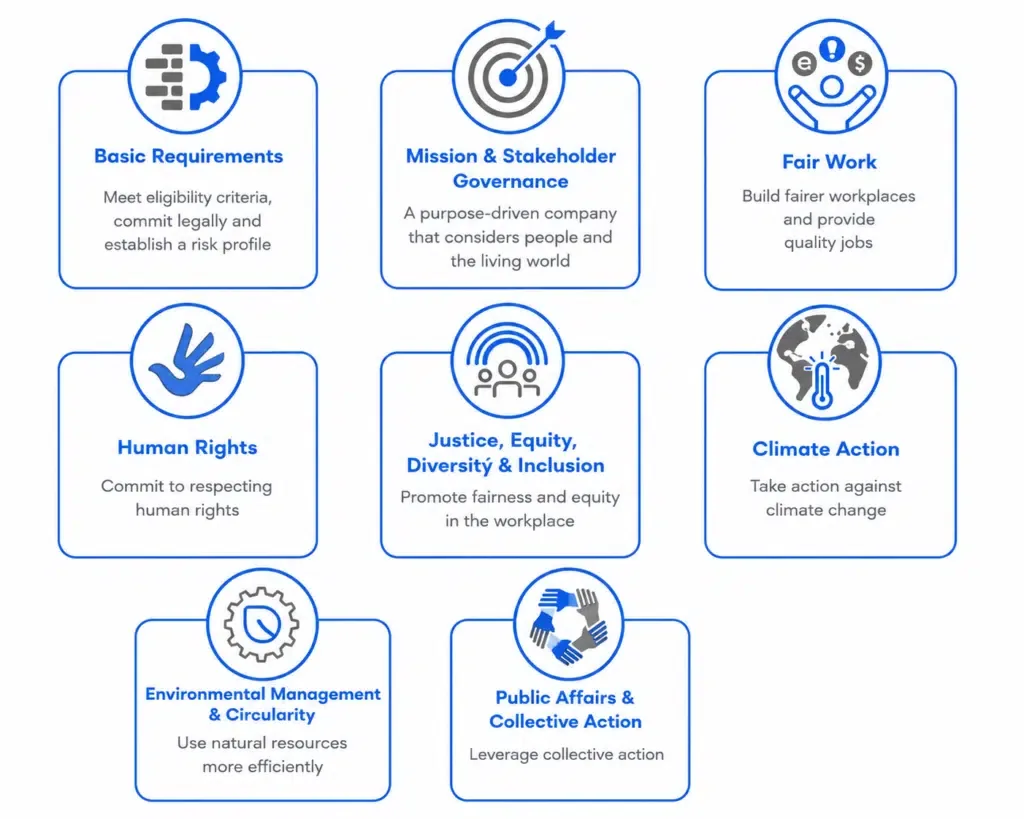
The 7 impact themes (V2 standards)
A new version of the B Corp® standards (V2), which is more rigorous and aligned with European regulations (notably the ECGT Directive), will serve as the benchmark starting in 2026. It introduces seven impact themes to which companies must respond with concrete actions:
- Mission and Stakeholder Governance: Establish a clear mission and make decisions that take all stakeholders into account.
- Climate Action: Implement concrete measures to reduce emissions and adapt to climate change.
- Justice, Equity, Diversity, and Inclusion: Promote an inclusive and equitable environment, both internally and within communities.
- Public affairs and collective action: contribute to initiatives and policies that promote a more just and sustainable economy.
- Fair labor practices: ensure quality working conditions and promote employee well-being.
- Human rights: respect and promote human rights across all activities and the value chain.
- Environmental management and circularity: reduce environmental impact and develop circular economy practices.
Why pursue B Corp® certification?
B Corp® certification delivers both internal and external benefits:
- Structure and improve your CSR practices: The BIA helps you pinpoint your company’s strengths and areas for improvement, and track your progress over time.
- Stand out and enhance your appeal: B Corp® certification sends a strong signal to customers, investors, partners, and talent seeking to engage with responsible companies.
- Anticipate regulatory requirements: the B Corp® process complements ESG reporting obligations, particularly the CSRD, and facilitates the structuring of necessary data and evidence.
- Join an international network of committed companies: B Corp® certification means becoming part of a global community of companies that share the same values, fostering the exchange of best practices and opportunities for collaboration.
- Guaranteed continuous improvement: recertification every three years requires demonstrating real progress, which anchors the process in the long term rather than as a one-off communication effort.
How do you obtain B Corp® certification?
The certification process involves several key steps and takes an average of 6 to 12 months:
- Complete the B Impact Assessment and achieve the minimum required score of 80 points.
- Substantiate your responses during a document review, as part of an independent verification process that complies with the requirements of ISO 17021-1.
- Amend your legal bylaws to formally incorporate social and environmental impact into your objectives and decision-making processes.
- Sign the B Corp® commitments and pay the annual fee.
- The certification is then formalized and published in the international B Corp directory.
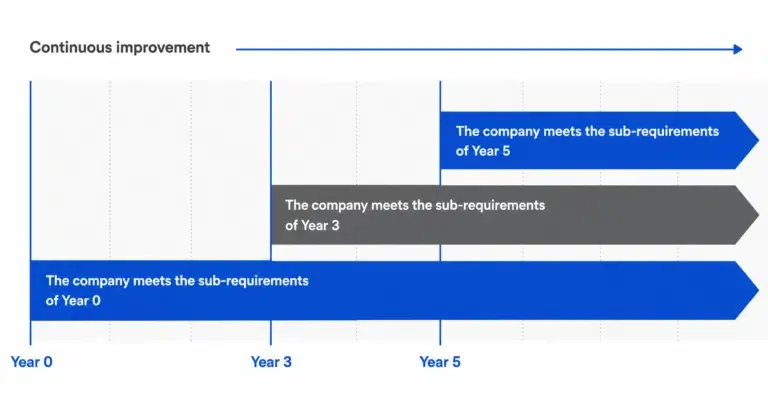
The certification is valid for 3 years. To maintain it, the company must not only recertify but also demonstrate continuous progress: requirements accumulate from one cycle to the next (years 0, 3, and 5), making the process increasingly demanding over time.
How can D-Carbonize help you achieve B Corp® certification?
B Corp® certification is based on rigorous and comprehensive requirements. Our experts can help you assess your current status, identify priority areas for improvement, and guide you in implementing your sustainability strategy to ensure you achieve certification.
Our support includes:
- Initial assessment: analysis of your current position relative to the BIA criteria and identification of gaps to be addressed.
- Carbon footprint assessment: measurement and reporting of greenhouse gas emissions (Scopes 1, 2, and 3) to meet the requirements of the Climate Action pillar.
- ESG framework: identification, formalization, and centralization of evidence related to policies, actions, and results across each thematic area.
- BIA Support: assistance with completing the questionnaire, strategic review, and verification of consistency between responses and supporting documents.
- Continuous Improvement Plan: definition of a roadmap for sustainable progress from one certification cycle to the next.
Would you like to assess your eligibility for B Corp certification or start your journey? Contact us!