Prove your product beats the competition, in kgCO₂e.
Product carbon footprints, life cycle assessments and EPD-ready data, product by product. One model, from the footprint your buyers ask for to the declaration your tenders need.
A customer needs it for its own Scope 3, or asks for it in a supplier questionnaire.
Declaration of performance & conformity
Mechanical resistanceDeclared
Reaction to fireDeclared
Climate change (GWP)New under the CPR
Other indicatorsFrom 2030
You make construction products
Under the new CPR, your product’s GWP is moving into the declaration that comes with the CE marking.
Eco-design scenarios
Current design
Green electricity
Recycled steel
Same method, comparable
You want a lower footprint to sell
Find what really reduces your product’s footprint, and say it in a way you can back up.
One product, its whole life
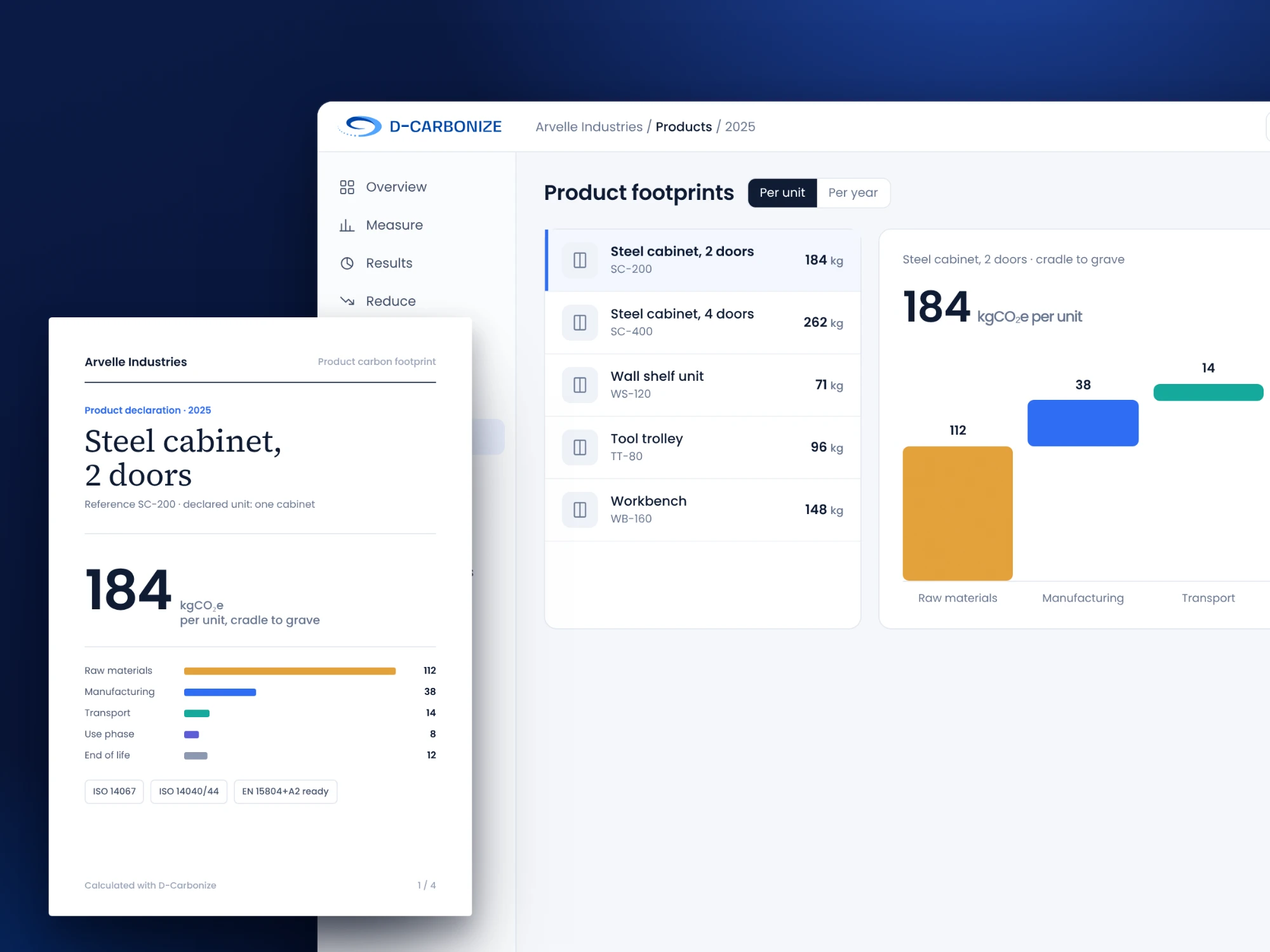
Where your product’s carbon comes from.
The same model gives the footprint your buyers ask for and the full life cycle an EPD needs. Switch the boundary, then pick a stage to see what goes into it.
Steel cabinet · Example product · 1 cabinet, used for 20 years
Module
Stage
kgCO₂e
In cradle to gate
A1–A2
Raw materials
112
Yes
A3
Manufacturing
38
Yes
A4
Transport
14
No
B
Use
12
No
C
End of life
8
No
Steel cabinetExample product · 1 cabinet, used for 20 yearsExample company
184kgCO₂e per cabinetModules A to C
Factory gate184 kg
Total
A1–A2 · Raw materials · 112 kgCO₂e · outside this boundary
What goes in
Steel sheet, paint, fittings and their transport to your plant.
Bill of materials
Supplier data or averages
Inbound transport
Eco-design lever
Where you can act
Recycled steel content and supplier choice weigh most here.
A3 · Manufacturing · 38 kgCO₂e · outside this boundary
What goes in
Energy and consumables used in your plant, allocated to each cabinet.
Energy invoices
Production volumes
Scrap rates
Eco-design lever
Where you can act
Energy mix, process efficiency and scrap.
A4 · Transport · 14 kgCO₂e · outside this boundary
What goes in
Delivery from your plant to the customer site.
Delivery distances
Transport mode
Load factor
Eco-design lever
Where you can act
Mode, distance and load factor.
B · Use · 12 kgCO₂e · outside this boundary
What goes in
Maintenance and replacement parts over 20 years of use.
Service life
Maintenance scenario
Eco-design lever
Where you can act
Durability and repairability.
C · End of life · 8 kgCO₂e · outside this boundary
What goes in
Dismantling, transport to treatment and disposal.
End-of-life scenario
Recycling rates
Eco-design lever
Where you can act
Design for disassembly and recycling.
Modules follow EN 15804 for construction products. Module D (benefits beyond the life cycle) is reported separately.
PCF, LCA or EPD?
Three questions to know what you need.
Most buyers need less than you think. Answer three questions; we tell you what to make, and what it involves.
Question 1
Who is asking?
Question 2
Is it a construction product?
Question 3
Must the result be published and verified?
What you need
Product carbon footprint (PCF)
ISO 14067
GHG Protocol Product Standard
PACT
Carbon only, usually cradle to gate. It is what customers plug into their Scope 3 and what supplier questionnaires ask for.
1Scope and declared unitWith you
2Data collection and modelOur experts, AI-assisted
3PCF report and shareable dataReady for your customers
One model in the Cockpit: you can extend a PCF to a full LCA or an EPD later.
What you need
Life cycle assessment (LCA)
ISO 14040
ISO 14044
Several environmental impacts over the whole life cycle. The basis for eco-design choices, and the step before any EPD.
1Goal, scope and functional unitWith you
2Life-cycle model and impactsOur experts
3Hotspots and eco-design leversFor your product teams
One model in the Cockpit: you can extend a PCF to a full LCA or an EPD later.
What you need
Environmental Product Declaration (EPD)
ISO 14025
EN 15804+A2
A verified, published declaration built on an LCA. For construction products, it is what architects, building assessments and public buyers use.
1LCA to EN 15804+A2Our experts
2Independent verificationExternal verifier
3Publication by a programme operatorB-EPD, INIES, MRPI and others
We prepare the LCA and the data. Verification and publication are done by an independent verifier and the programme operator.
Construction products
Your product’s GWP is becoming part of the CE marking.
Under the new Construction Products Regulation, environmental performance enters the declaration of performance and conformity, product family by product family.
TODAY
8 Jan 2026New CPR applies · GWP firstClimate change (GWP) is the first environmental characteristic to declare, once your family’s harmonised standard is cited.
9 Jan 2030Core indicatorsThe core EN 15804+A2 environmental indicators follow.
9 Jan 2032Full life-cycle indicatorsThe complete set of environmental indicators.
Product by productYour family’s rulesEach obligation applies once your family’s harmonised standard is cited, with at least a year to adapt.
Already today in Belgium, any environmental claim on a construction product must be backed by an EPD registered in the federal database (Royal Decree of 22 May 2014). FPS Public Health ↗
How it works
What you get, and how we get there
You choose the products. We build the model with your teams and keep it up to date.
Study scopeAgreed
ProductSteel cabinet
Declared unit1 cabinet
Service life20 years
BoundaryCradle to grave
StandardsISO 14067 · EN 15804+A2
Phase 01 of 05
Scope
With you
We choose the products and the declared or functional unit with you.
We agree the boundary: cradle to gate, or the full life cycle.
You receiveProducts, unit and boundary agreed
Data collectionAI
XLSBOM_cabinet.xlsx42 linesMatched
PDFEnergy_2025.pdf3 invoicesMatched
CSVDeliveries_2025.csv1,280 rowsMatched
PDFPaint_TDS.pdfTechnical sheetMatched
Phase 02 of 05
Collect
Your teams + AI
Your teams send bills of materials, energy and transport data as they are.
AI reads the files and matches materials to emission factors.
You receiveBills of materials and process data in the Cockpit
Life-cycle model
A1–A3Product
→
A4Transport
→
BUse
→
CEnd of life
Steel: supplier dataReviewed
Paint: database averageReviewed
Service life: 20 yearsReviewed
Phase 03 of 05
Model
Our experts
Our experts model each stage and review every assumption.
Supplier data replaces averages wherever it exists.
You receiveA reviewed life-cycle model
Steel cabinet · Results
184kgCO₂e per cabinet
Raw materialsManufacturingTransportUseEnd of life
Hotspot: steel sheet. Lever: recycled content.
Phase 04 of 05
Results
Our experts
Results by stage, with the hotspots that matter.
Eco-design levers ranked by impact: materials, energy, logistics.
You receiveFootprint per product, stage by stage
Product carbon footprint
Steel cabinet · ISO 14067150 kgCO₂eCradle to gate, per cabinet
Environmental Product Declaration
EN 15804+A2 · Modules A–D
Verified by a third party
Phase 05 of 05
Declare
Our experts + third parties
A PCF report and data your customers can use.
For an EPD: an LCA to EN 15804+A2, then independent verification and publication by the programme operator.
You receiveA PCF report, or an EPD ready for verification
AI collects, experts check. Every figure traceable to its source.
They measured with us
Renovating a 60-tonne haul truck instead of buying new
New truck
Renovated
−92 % CO₂
“D-Carbonize is easy to use, implement and to understand.”
A PCF covers carbon only (ISO 14067). An LCA covers several environmental impacts over the life cycle (ISO 14040/44). An EPD is a verified, published declaration built on an LCA (ISO 14025, and EN 15804+A2 for construction products).
Do you publish the EPD?
We prepare the LCA and the data to EN 15804+A2. Verification is done by an independent verifier, and publication by a programme operator such as B-EPD, INIES or MRPI.
Cradle to gate or cradle to grave?
Most customers ask for cradle to gate, for their own Scope 3. An EPD for construction products covers at least the product stage, end of life and module D. We build one model and give you both.
Can we compare our product with a competitor's?
Only on the same basis: same method, same unit, same boundary and, for EPDs, the same product category rules. We tell you when a comparison holds, and when it does not.
Do we need an EPD to make a green claim?
For construction products in Belgium, yes: any environmental claim must be backed by an EPD registered in the federal database. More broadly, claims such as "carbon neutral" based on offsetting are banned for consumer products in the EU since September 2026.
Will the standards change?
Yes. ISO 14067 is being revised, and ISO and the GHG Protocol are working on a joint product standard. Your model stays in the Cockpit, so updating it to new rules does not mean starting again.
Next step
We start from your bill of materials, not from a database average.
A first 15-minute call to understand where you stand and what you need. No commitment.



 14067