Most of your emissions sit with your suppliers.Get their data.
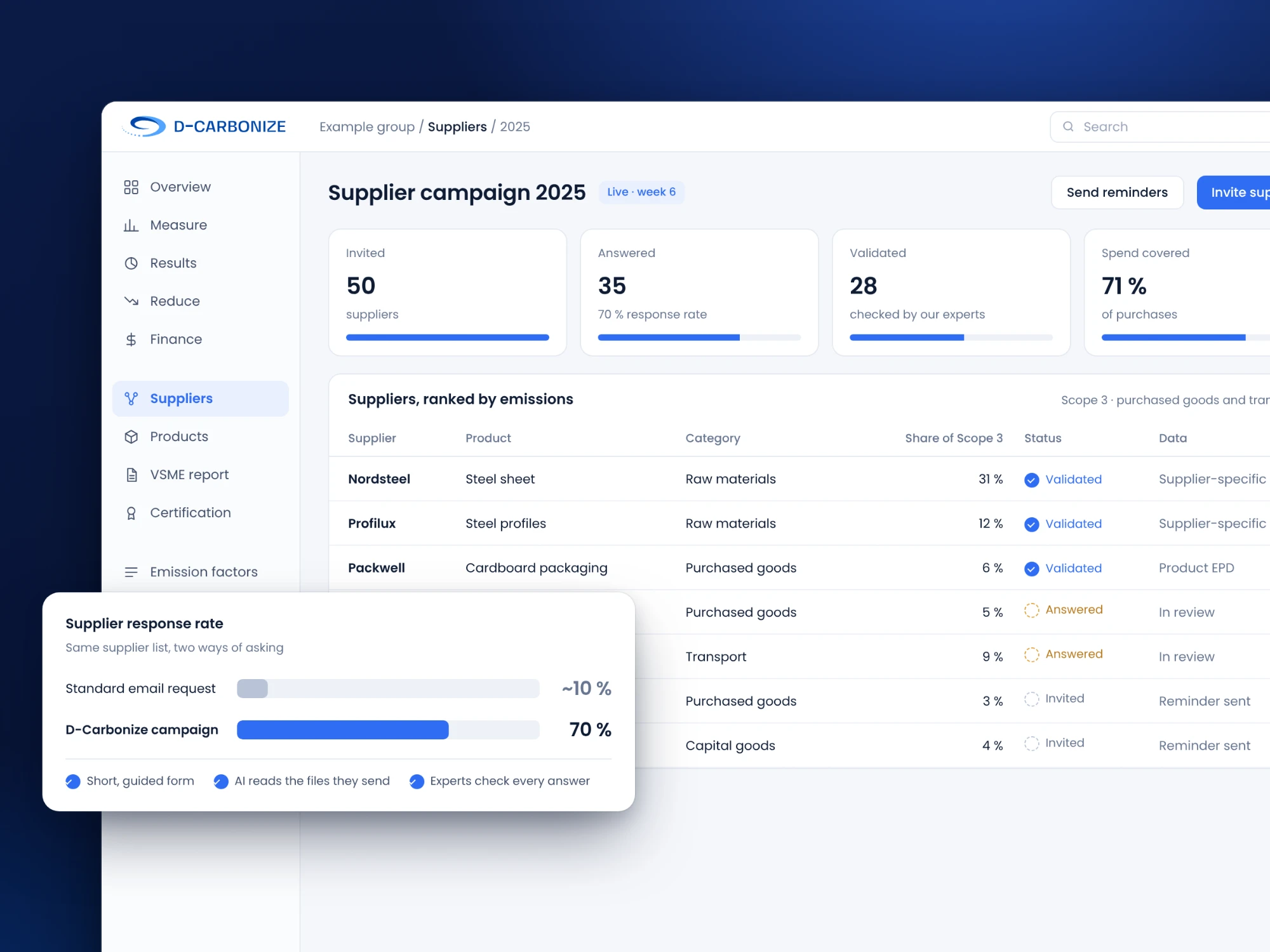
We find the suppliers that matter, run the campaign with you and turn their answers into supplier-specific data in your footprint. AI reads what comes back; our experts check it. In our campaigns, 60–80 % of suppliers answer, up from about 10 % with a standard email.
Raw materials, components and subcontracting usually make up most of an industrial footprint. Averages hide who you buy from.
SBTi targetScope 3 coverageSupplier data
Ladder auditStep 2 · chain analysisSupplier data
Key clientSupplier questionnaireSupplier data
You have a Scope 3 target or a Ladder step
An SBTi target, Step 2 or 3 of the CO2 Performance Ladder, or a key client asks for real supplier data.
Verified
CBAM declaration · 2026 imports
GoodsFlat-rolled steel
OriginNon-EU producer
Default value+ mark-upActual valueFrom producer
You import steel, aluminium or cement
From outside the EU, under CBAM, you need your producers' actual embedded emissions.
On average, Scope 3 emissions are 26 times greater than a company's operational emissions (CDP).
From averages to real data
Your Scope 3 only moves if your data can.
With averages, your purchases count the same whoever you buy from. Supplier data makes your suppliers' efforts, and your purchasing choices, show in your footprint. Pick a method, then see what moves your figure.
What if…
Method
You buy less steel
Your supplier cuts its emissions
You switch to a lower-carbon steel
Steel prices rise by 10 %
Spend-basedEuros spent × factor per euro
Falls
No change
RisesA pricier low-carbon steel looks worse.
Rises+10 %, with no extra tonne emitted.
Average dataTonnes bought × industry average
Falls
No change
No change
No change
Supplier dataThe supplier’s own footprint, allocated to you
Falls
FallsIts own reductions flow into your figure.
No changeUnless its company average falls.
No change
Product dataThe footprint of the exact product you buy
Falls
FallsWhen it reaches the product you buy.
FallsThe grade you buy is what counts.
No change
PurchaseSteel sheetExample companySteel supplier A · 70 t bought in 2025
How it is calculated
SpendFrom your ledger
×
Factor per euroSteel, sector average
=
ResultRough estimate
What the supplier sends: Nothing. Your purchase ledger is enough.
How specific the figure is
GenericSpecific to what you buy
How it is calculated
Quantity70 t
×
Industry average1.89 t CO₂e/t
=
Result132.3 t CO₂e
What the supplier sends: Nothing. Quantities from your invoices.
How specific the figure is
GenericSpecific to what you buy
How it is calculated
Quantity70 t
×
Supplier’s intensityFrom its footprint
=
ResultSupplier-specific
What the supplier sends: Its company footprint, or a short questionnaire.
How specific the figure is
GenericSpecific to what you buy
How it is calculated
Quantity70 t
×
Product footprintFrom the PCF or EPD
=
ResultProduct-specific
What the supplier sends: A product carbon footprint or an EPD.
How specific the figure is
GenericSpecific to what you buy
What moves your Scope 3
Only your spending moves it.
A price rise looks like more emissions; a discount looks like less. Good for a first screening, not for steering.
Only the quantity you buy moves it.
Every tonne of steel counts the same, whoever made it. Your Scope 3 falls only if you buy less.
Your supplier’s progress shows in your footprint.
When this supplier cuts its emissions, your Scope 3 reflects it. You can see which suppliers are reducing and steer your purchasing.
Your purchasing choices show too.
Switching to a lower-carbon steel grade counts in your footprint. This is the data your own clients and tenders increasingly ask about.
What if…
You buy less steelFalls
Your supplier cuts its emissionsNo change
You switch to a lower-carbon steelNo change
Steel prices rise by 10 %No change
The GHG Protocol allows all four methods and lets you mix them. A more specific method is not automatically more accurate, so our experts check what suppliers send.
Why suppliers answer
Suppliers don't have to answer. So we make it easy.
Every supplier gets a request that matches what it already has. Nobody is asked for a footprint they have never made.
Since the Omnibus law of 2026, suppliers with up to 1,000 employees can decline to share more than the EU Voluntary Standard (VSME) covers. Large companies cannot impose more by contract. A good campaign wins answers; it cannot force them. Directive (EU) 2026/470 ↗
Typically: large producers, listed groups
Upload what exists.
They receiveA personal link
In their language. No account, no licence to buy.
They sendTheir footprint, PCF or EPD
As it is, PDF or spreadsheet.
You getSupplier or product data
Read by AI, checked by our experts, in your Cockpit.
Typically: SMEs, subcontractors
Answer a short form.
They receiveA short form
Energy, fuels, main materials, production volume.
They sendA few figures they already have
From their own invoices and records.
You getA supplier intensity
We build it with them, allocated to what you buy.
Typically: very small suppliers, traders
Keep the average, flag it.
They receiveA simple invitation
To join next year’s campaign.
You keepA recognised average
So your footprint stays complete.
You seeWhere data would matter
Flagged in the Cockpit, ranked by weight.
AIAnswers are read and matched automatically; reminders go out on their own. Our experts check every figure before it reaches your footprint.
CBAM
Importing steel, aluminium or cement?
Under CBAM, you declare the emissions embedded in what you import. Actual values need verified data from your non-EU producers; without them, you fall back on default values that include a mark-up.
We collect the producers' data, check it and prepare it for your declaration.
Same campaign, same Cockpit: your non-EU producers send their embedded emissions, our experts check them against the CBAM rules, and the values are ready for your annual declaration.
Iron & steel
Aluminium
Cement
Fertilisers
Hydrogen
Electricity
TODAY
1 Jan 2026Definitive period startsImporters above 50 t a year of CBAM goods are in scope.
1 Feb 2027Certificate sales openCertificates cover the emissions you declare.
30 Sep 2027First annual declarationFor goods imported in 2026, with embedded emissions per product.
XLSTransport_questionnaire.xlsxShort formUnit to check
Phase 03 of 06
Read
AI
AI reads questionnaires, footprints, PCFs and EPDs, and extracts the values.
Missing values, wrong units and outliers are flagged.
You receiveEvery answer in the Cockpit
Data quality · Supplier A
TechnologyRepresentative
Time periodRepresentative
GeographyRepresentative
CompletenessRepresentative
ReliabilityRepresentative
Checked by an expert
Phase 04 of 06
Check
Our experts
We check each answer against the GHG Protocol data quality criteria.
Anything we cannot rely on stays an average, and is flagged.
You receiveValidated supplier data
Scope 3 · Purchases
Steel sheetSupplier data
Steel profilesProduct data (EPD)
TransportSupplier data
PaintAverage
Phase 05 of 06
Integrate
Our experts
Supplier data replaces averages wherever it exists.
You see which suppliers are reducing, to steer your purchasing.
You receiveYour footprint, with the data type on every line
Share of supplier-specific data
Year 1Year 2Year 3
Supplier-specificAverages
Phase 06 of 06
Every year
You, with less effort
The same suppliers update their data; new ones join.
Your share of supplier-specific data grows year on year.
You receiveA campaign that grows
AI collects, experts check. Every figure traceable to its document.
They measured with us
63.67% purchases
Purchases 63.67%Everything else
“We are satisfied with the cockpit tool. Once you understand the basics of a carbon audit, the tool is quite intuitive. It helps you understand the numbers and what lays behind. We also appreciated the prompt reactions from the account team.”
Catherine Willemart, Marketing & ESG activator, IPEXRead the case →
From factory insight to concrete steps
“With D-Carbonize, we gained insight into the carbon impact of our operations and took concrete steps to make our paint factory more environmentally friendly.”
Romain Williquet, Managing Director, DragopaintRead the case →
We keep a recognised average and flag it, so your footprint stays complete and you see where better data would change the picture.
Can our suppliers refuse?
Yes. Since 2026, suppliers with up to 1,000 employees can decline to share more than the EU Voluntary Standard covers. That is why we adapt each request to what the supplier already has, and keep it short.
Which suppliers should we start with?
The few that weigh most in your footprint, usually your main raw materials and subcontracting. We rank them from your purchase ledger before anything is sent.
Does it work for subcontractors on construction sites?
Yes. Subcontractors usually fit the "knows its energy" path: fuel, machinery hours and materials, from their own invoices.
Is supplier data required by SBTi?
For large companies, the SBTi Net-Zero Standard V2, which takes effect on 1 February 2027, requires Scope 3 targets covering every category above 5 % of Scope 3, and allows supplier alignment targets. For smaller companies, Scope 3 targets are optional.
Will the Scope 3 standard change?
Yes. The GHG Protocol is revising its Scope 3 standard with ISO. Draft proposals include breaking down emissions by data type, to reward primary data. What we collect today stays usable.
What about CBAM?
If you import CBAM goods from outside the EU above 50 tonnes a year, your first annual declaration is due by 30 September 2027. We collect and check your producers' embedded emissions in the same campaign.
Next step
We start from your sites, not from a spreadsheet.
A first 15-minute call to understand where you stand and what you need. No commitment.



 14064-1