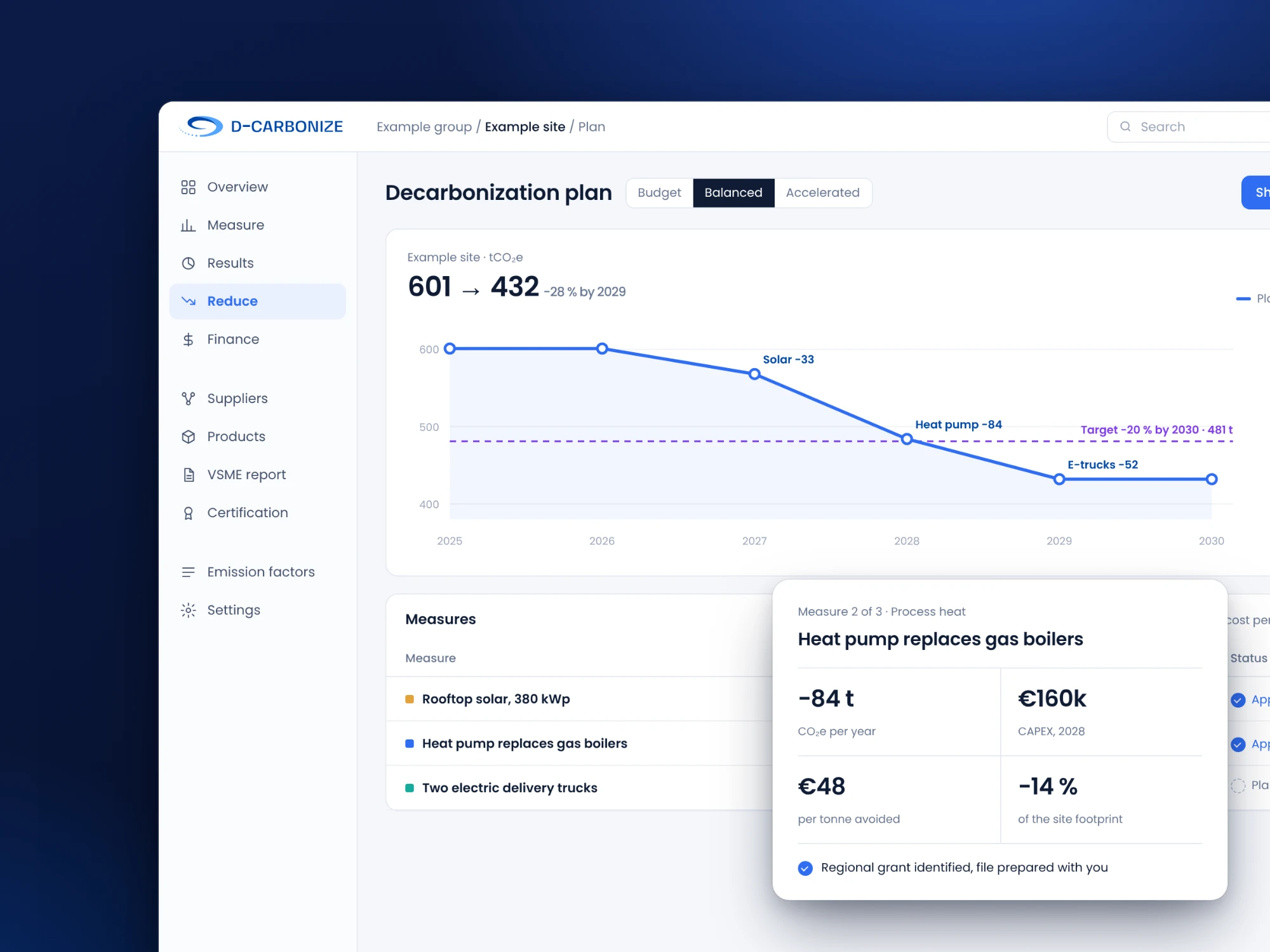
A target you can defend, set with the SBTi method, then every measure priced in tonnes and in euros and ranked by return. Your roadmap becomes a capital allocation plan. SBTi V2-ready.
A target alone convinces no one. Management wants to see how you reach it, and what it costs.
CAPEX requests · next year
New press lineProduction
ERP upgradeIT
Rooftop solarPays back in 4.5 years
Warehouse rackingLogistics
Every euro competes
Climate projects sit next to every other investment request. They need a payback, not a slogan.
SBTi targetV2
Base year2025
Scope 1Own target
Scope 2Own target
SubmissionUnder the new standard
You have an SBTi target to set or renew
Until January 2028 you choose between the current rules and V2. After that, every new target follows V2.
SBTi · New net-zero standard
SBTi changed its rules. Here is what it means for you.
Three dates, and what changes depending on your size.
11 June 2026V2 published
1 February 2027V2 opens for validation
31 January 2028V2 for every new target
Category B · most SMEs
One target for Scope 1, one for Scope 2
Scope 3 target optional
A transition plan, not required to publish
Category A · larger companies
Targets on Scopes 1, 2 and 3
Base-year inventory verified
A transition plan, published
1,000+ employees or €450M+ turnover, or two of: 250+ employees, €50M+ turnover, €25M+ balance sheet.
Already have a validated target? It stays valid until its end year. Source: SBTi Corporate Net-Zero Standard V2.0, 2026.
Target and plan
A target, then a plan that reaches it.
We set the target with the SBTi method, then price every measure that gets you there, in tonnes and in euros. Switch measures on and off, or pick a scenario: the plan shows whether you reach the target, and at what cost.
Example site · base year 2025Scopes 1 and 2: 334 tCO₂e a year
Measures, the most profitable first
Your plan2 of 3 measuresTarget reached by 2030−26 %Scopes 1 and 2
Scopes 1 and 2, tCO₂e a year
334 → 248 by 2030, −26 %
Reaches the target
Your planSBTi target, −4.2 % a year
To invest
€400k
Saved a year
€55k
Avoided a year
−85 t
Over the equipment's life
+€645k
Example: the site of our example company and its three measures. Cost per tonne over the equipment's life: investment minus savings, divided by the tonnes avoided. Grants not included. Scope 3 gets its own target.
Who asks for it
A target and a plan: the question comes from everywhere.
Ratings, labels, tenders and regulators ask for the same building blocks. One target and one plan answer all of them.
“The Carbon Cockpit tool is very easy to use and we have received the information we need to be almost autonomous for the next financial year. In addition, D-Carbonize responds quickly and accurately to specific requests for clarification on technical points. We are fully satisfied with our consultants Lauranne and Frédéric.”
Benoît Lemince, Sustainability Director, I-careRead the case →
Frequently asked questions
Do we need official SBTi validation?
No. Validation is voluntary, and you can follow the method without it. Some buyers, EcoVadis's top carbon level and large B Corps ask for a validated target. Under V2, Category A companies also need their base-year inventory verified.
Which SBTi route fits a mid-sized company?
Until 31 January 2028, most SMEs can use the SBTi's SME route: a target on Scopes 1 and 2, and a commitment to measure and reduce Scope 3. From 1 February 2027, they can also submit under V2 as Category B. We check which route fits your size and timing.
Do we have to publish a transition plan?
It depends. Under SBTi V2, Category A companies publish theirs; Category B companies need one but are not required to publish it. In France, BEGES asks for one above 500 employees. CSRD asks you to describe it if you have one.
Are grants included?
Yes, every measure shows the grants and financing it can claim.
Can offsetting count toward the target?
No. It only covers what’s left at the end, never instead of reducing.
Next step
We start from your sites, not from a spreadsheet.
A first 15-minute call to understand where you stand and what you need. No commitment.